

The Dealer’s Day: Before and After
For a dealer on a non-RFID table, the end of every hand involves a ritual that is equal parts muscle memory and genuine cognitive load: counting chips in each betting position, counting the chip tray, calling out chip totals to the pit supervisor, and waiting for verification before the next round begins. At a busy baccarat table with six player positions, multiple side bets, and chip stacks of varying heights, this counting process takes 20–40 seconds per round — time that slows the game, creates a different pace for VIP players who expect rapid play, and introduces the risk of counting errors under time pressure.
On an RFID table, the counting happens invisibly. The reader under the felt scans all chip positions continuously, and the TMS updates the chip count in real time on the pit supervisor’s monitor. The dealer’s end-of-hand process is reduced to three steps: close the hand, make the payouts, call the new round. The supervisor confirms chip counts from the screen rather than verbal callout.
| Without RFID | Without RFID |
| Step 1Visually assess chip totals at each betting position | Step 1Close the hand — chip counts already recorded by reader |
| Step 2Manually count each chip stack in the tray | Step 2Make payouts from the TMS-verified chip count |
| Step 3Call chip count to pit supervisor | Step 3Call new round — supervisor sees counts on screen |
| Step 4Wait for supervisor verification | Step 4Continuous verification — alerts only if discrepancy |
The time savings per hand accumulate to approximately 15–30 seconds per round. At a baccarat table running 40 hands per hour, this recovers 10–20 minutes of game time per hour — translating to 80–160 additional hands per shift and meaningfully higher revenue per table per day.
The casino floor dashboard showing real-time chip movement across multiple RFID tables. Each row represents a table; chip counts, game state, and anomaly alerts update continuously without dealer intervention.
The Pit Manager’s View: From Reactive to Proactive
A pit manager on a traditional casino floor spends most of their attention budget on the three tasks that consume the most time: monitoring table counts (is the chip float balanced?), catching dealer errors (did the dealer overpay the Player bet?), and managing table utilization (are we staffed correctly for current demand?). All three tasks are reactive — problems are identified after they occur, often by which point the financial impact has already been absorbed.
With RFID, the pit manager’s role shifts from reactive oversight to proactive management. The TMS provides a live dashboard showing chip counts, game win/loss, and fill/credit history for every table in the pit simultaneously. Anomalies — a table with a chip count that does not match the game outcome, a dealer whose error rate exceeds the acceptable threshold, a table running significantly above or below theoretical win — surface automatically as alerts rather than being discovered through manual review.
The Old Pit Manager
Verifies chip counts by phone and clipboard. Identifies anomalies at end of shift. Staffs tables based on gut feel. Investigates discrepancies days after they occur.
The RFID Pit Manager
Monitors live dashboard across all tables simultaneously. Receives instant alerts for discrepancies. Adjusts staffing from real-time floor data. Closes discrepancies before the shift ends.
The practical consequence is a dramatic reduction in end-of-shift reconciliation meetings. On a non-RFID floor, a 6-table pit might generate 3–5 chip count discrepancies per shift requiring investigation, averaging 15–20 minutes of supervisor time each. With RFID, the TMS flags only genuine exceptions — typically 0–1 per shift — and provides the complete transaction history for each flagged chip movement, so the investigation takes minutes rather than an hour of reviewing security footage.
Casino Security: Instant Chip Authentication
For the casino security team, the most consequential operational change from RFID is the elimination of the authentication gap. On a traditional floor, chip authentication at the cage is a visual and tactile process: the cashier examines the chip’s edge spots, label, and weight against a reference chip, and makes a judgment call. Counterfeit chips that pass visual inspection — and some sophisticated counterfeits do — enter the chip float and must be tracked down later.
The RFID cage reader closes this gap completely. Every chip presented at the cage for cash-out passes through the reader’s field. The reader queries the chip database using the chip’s UID and returns a verification result within 200 milliseconds: valid, unregistered, or flagged. A flagged chip — reported lost or stolen — triggers a silent alert to security while the transaction proceeds normally at the window, allowing security personnel to intercept the presenter before they leave the property.
Real scenario: A patron presents 12 high-denomination chips for cash-out. The cage reader flags one chip — the UID is registered as stolen from a table the patron was seated at two hours earlier. The TMS alert reaches the floor security supervisor’s device simultaneously. Security intercepts the patron at the cage exit. The chip is recovered; the investigation begins.
Surveillance: The Audit Trail Changes Everything
Casino surveillance teams are the primary beneficiaries of RFID’s data completeness. Every chip movement on an RFID table generates a timestamped record in the TMS: which chip, which table, which position, at what time, in what game outcome. This record exists independently of floor staff testimony, supervisor notes, or camera footage interpretation.
When a dispute arises — a player claims they had a larger bet on the table, or a dealer disputes a fill discrepancy — the RFID record is definitive. The TMS can reconstruct the exact chip state at any point in the game with second-level precision. This eliminates the “he said, she said” dynamic that makes many floor disputes difficult to resolve and significantly reduces the number of disputes that escalate to management review.
For internal investigations, the RFID data stream provides a new layer of analytical capability. Security teams can run pattern analysis across the chip movement data: chips moving unusually between tables, betting patterns that do not match the chip flow, chips from unverified sources entering the floor. These patterns are visible in the data before they would be detectable through manual observation.
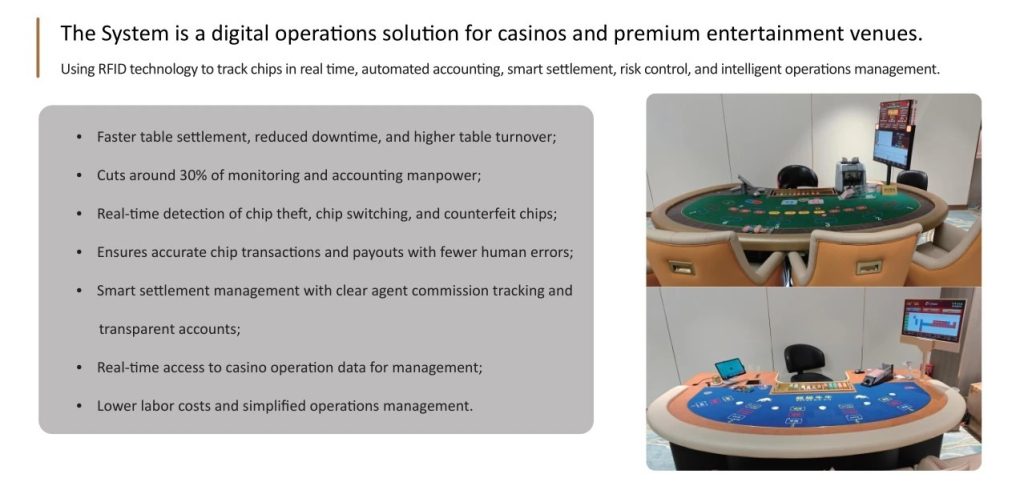
RFID casino chips on a live Baccarat table. The embedded inlay in each chip transmits its unique identifier to the reader beneath the felt on every placement and removal — creating a complete, timestamped record of chip movement throughout each hand.
Staffing: How RFID Changes the Pit
Perhaps the most immediately noticeable change for floor staff is the reduction in the supervisory overhead per table. A traditional pit with 8 tables might require 2 supervisors during peak hours and 1 during off-peak — the supervisors are occupied with count verification, callout coordination, and exception investigation throughout their shift. With RFID, the TMS performs most of this work automatically, and a single supervisor can effectively oversee 12–16 tables during off-peak hours without sacrificing oversight quality.
This staffing optimization does not mean job cuts in practice — most operators redeploy the efficiency gains as coverage improvements elsewhere on the floor or invest the labor savings in enhanced guest service roles. But it does mean that the ratio of supervisors to tables improves significantly, which has a direct effect on floor safety and the ability to respond to patron needs quickly.
For casino operators, this staffing flexibility is one of the most operationally valuable features of an RFID deployment. Rather than maintaining a fixed staffing model based on worst-case floor coverage requirements, supervisors can be allocated based on real-time demand data from the TMS, moving to areas that need coverage when tables open or close and returning to normal patrol when demand is low.
The pit manager dashboard that powers this visibility is one of the core features operators should evaluate when selecting table hardware. Macaumr RFID gaming tables include a standard TMS integration interface that feeds real-time chip movement data to the pit management dashboard, enabling the workflow improvements described above without requiring custom integration development.
Frequently Asked Questions
Does RFID eliminate the need for casino surveillance cameras?
No. RFID provides electronic chip movement data but cannot capture physical events — the appearance of individuals, body language, card manipulation, or any non-chip interaction. Surveillance cameras and RFID data are complementary: RFID provides the electronic audit trail; cameras provide the visual record of who was present and what they did.
What happens to a dealer’s job when chip counting is automated?
Dealers are not replaced — their role changes. The manual counting tasks that occupied time between hands are eliminated, which means dealers can focus more on the quality of the game experience: pace, patron interaction, and game integrity. Most operators report that dealers adapt positively to RFID tables once they experience the reduced cognitive load during fast-paced hands.
Can pit supervisors override RFID chip counts?
In a properly configured TMS, supervisor overrides are logged but restricted. If a supervisor enters a manual chip count adjustment, the system records who made the adjustment, at what time, and whether the override was within acceptable tolerance. Large or repeated overrides trigger automatic review flags. The audit trail exists regardless of whether an override was permitted.
What training do floor staff need for RFID tables?
Most operators find that dealer training takes 2–4 hours — primarily focused on the TMS interface, how to read the chip count display on the table terminal, and the new procedure for requesting fills and credits. Pit supervisor training is more substantial (1–2 days) because it covers the dashboard, alert response protocols, and override procedures. Vendor-supplied training is typically included in the hardware purchase.
Can RFID data be used to evaluate individual dealer performance?
Yes. RFID data can track dealer error rates — specifically, the frequency with which the TMS generates payouts that differ from what the dealer called. This is an objective performance metric that supplements (but does not replace) supervisory observation. It is most useful for identifying dealers who may benefit from additional training rather than as a punitive metric.
Macaumr supplies casino RFID gaming tables and integrated pit management hardware for operators worldwide. Visit Macaumr casino solutions overview to explore the full product range including RFID tables, cage readers, and TMS integration options.
