

Please add the complete SEO details for this article, including the meta title, meta description, focus keyword, keywords, tags, and image SEO (image title, alt text, caption, description, and file name) before publishing.
Must ad on Google Search Console
Article title
Assisted Living in Tucson: What Families Should Look for Beyond the Brochure
urlLabel
choosing-assisted-living-tucson
Meta title
Choosing Assisted Living in Tucson: A Family Guide
Meta description
Explore what to look for when choosing assisted living in Tucson, from caregiver experience and daily routines to costs, safety, and residential care options.
Keywords
assisted living in Tucson, assisted living Tucson AZ, Tucson assisted living facilities, senior living in Tucson Arizona, residential assisted living homes Tucson, Tucson senior care, assisted living homes in Arizona, senior residential care Tucson, elderly care homes Tucson, Tucson assisted living communities, residential care homes Tucson AZ, how to choose assisted living in Tucson, what to look for in an assisted living facility,
Image SEO Data
|
Field |
Recommended value |
|
Image file name |
assisted-living-tucson-arizona-senior-care.jpg |
|
Image title |
Assisted Living in Tucson Arizona |
|
Alt text |
Older adult speaking with a caregiver in a welcoming Tucson assisted living residence |
|
Image caption |
Choosing assisted living in Tucson means looking beyond amenities to everyday care, caregiver support and resident comfort. |
|
Image description |
A senior resident talking with a caregiver in a comfortable residential assisted living environment, representing the importance of evaluating caregiver experience, daily routines, safety and personal attention when choosing senior care in Tucson, Arizona. |
Assisted Living in Tucson: What Families Should Look for Beyond the Brochure
Choosing an assisted living community for an older family member is rarely as simple as comparing locations and prices. Families want to know whether their loved one will receive appropriate care, feel comfortable in unfamiliar surroundings, and continue enjoying the routines that make daily life meaningful.
In Tucson, Arizona, senior living options range from large residential communities to smaller assisted living homes. Each setting approaches caregiving differently, making it important to understand what lies behind attractive photographs, amenity lists, and promises of personalized attention.
The most useful approach is to focus on how a residence operates day to day, how it responds to changing care needs, and whether its environment fits the individual who will live there.
Start With the Level of Assistance Actually Needed
Before scheduling tours, families should identify which daily activities have become difficult to manage independently.
An older adult may need occasional reminders to take medication, while another person may require hands-on assistance with bathing, dressing, walking, or eating. Some individuals remain physically active but benefit from regular supervision and companionship.
Consider several practical questions:
- Can the person safely prepare meals and maintain adequate nutrition?
- Are medications taken correctly and on schedule?
- Is there an increased risk of falls or difficulty moving around the home?
- Does the person need assistance with personal hygiene or dressing?
- Has loneliness or social withdrawal begun affecting daily life?
- Are family caregivers struggling to provide consistent support?
These observations help establish which services matter most. A residence with extensive recreational amenities may be appealing, but appropriate staffing and reliable personal care should take priority.
A healthcare professional familiar with the person’s medical history can also help determine whether assisted living is suitable or a higher level of medical care is necessary.
Understand the Differences Between Assisted Living Options
The term senior living covers several arrangements that serve different needs.
Independent living communities generally accommodate older adults who can manage their personal care but prefer convenient housing, social activities, and reduced household responsibilities.
Assisted living residences provide additional support with activities of daily living, such as bathing, dressing, meals, medication management, and mobility.
Skilled nursing facilities serve people who require more extensive nursing services or medical supervision.
Within assisted living, families may also choose between larger communities and residential care homes.
Residential assisted living homes typically operate on a smaller scale, with shared living areas, familiar household routines, and fewer residents. Larger communities may offer more extensive facilities, group activities, and communal spaces.
Neither arrangement is automatically superior. A person who enjoys a busy social environment may appreciate a larger community, while someone who values quieter surroundings may prefer a smaller residential setting.
When comparing assisted living in Tucson, the important question is whether the residence can consistently meet the individual’s needs rather than simply whether it offers the longest list of amenities.
Pay Attention to Staffing and Caregiver Continuity
The quality of everyday care depends heavily on the people providing it.
During a visit, ask how many caregivers are on duty during the day and overnight. Find out how responsibilities are divided and what happens if a staff member is absent.
Caregiver continuity is especially important for residents who need assistance with personal routines. Familiar staff members can learn a person’s preferences, communication style, mobility limitations, and usual behavior.
Families should ask:
- What qualifications and training do caregivers have?
- How long do caregivers typically remain employed?
- Who supervises the care team?
- How are emergencies handled overnight?
- What procedures are followed when a resident’s health or behavior changes?
- How frequently are individual care plans reviewed?
It is also useful to observe how caregivers communicate with residents. Respectful explanations, patience, and attention to personal preferences often reveal more about the care environment than prepared presentations.
Consider the Importance of Daily Routines
A comfortable residence should offer more than a bedroom and assistance with basic tasks.
Daily routines contribute to a sense of independence, familiarity, and purpose. Meals, conversations, hobbies, exercise, and visits from relatives can all influence how residents experience their surroundings.
Ask to see a typical weekly activity schedule. Determine whether participation is optional and whether activities accommodate people with different physical or cognitive abilities.
Meal arrangements also deserve attention. Some residents have medical dietary requirements, while others simply have longstanding preferences or cultural traditions surrounding food.
Families should find out whether meals are freshly prepared, whether individual preferences can be accommodated, and whether assistance is available for residents who need help eating.
Outdoor spaces may be another consideration in Tucson. Accessible patios, shaded sitting areas, and safe walking paths can make it easier to enjoy fresh air, particularly when activities are scheduled around the region’s hot weather.
Review Costs and What the Monthly Fee Includes
Assisted living pricing can be difficult to compare because providers may structure their fees differently.
One residence may include meals, housekeeping, laundry, medication assistance, and personal care in a standard monthly rate. Another may charge separately for particular services or levels of support.
Before signing an agreement, request written clarification on:
- The base monthly fee and included services
- Additional charges for personal care or medication assistance
- Transportation and appointment-related expenses
- Deposits, move-in charges, and refund policies
- How costs change when care needs increase
- Conditions that might require a resident to move elsewhere
Families should also discuss anticipated future needs. Someone who currently requires limited assistance may later need greater supervision or mobility support.
Understanding what a residence can accommodate over time can reduce the possibility of an unexpected second move.
Visit in Person and Look Beyond the Presentation
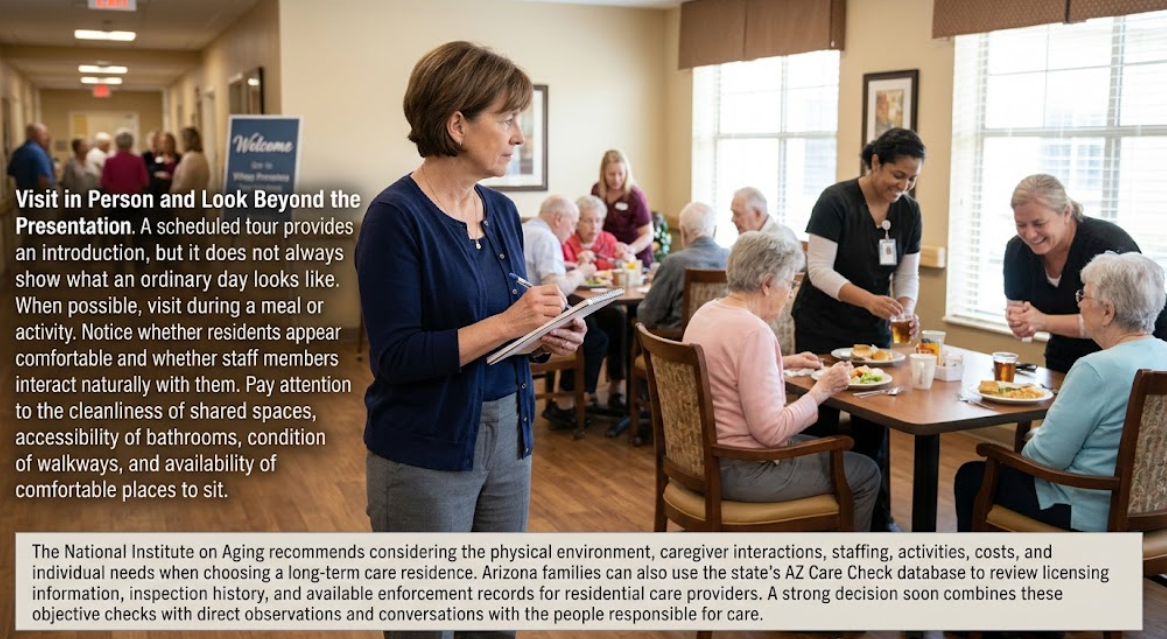
A scheduled tour provides an introduction, but it does not always show what an ordinary day looks like.
When possible, visit during a meal or activity. Notice whether residents appear comfortable and whether staff members interact naturally with them.
Pay attention to the cleanliness of shared spaces, accessibility of bathrooms, condition of walkways, and availability of comfortable places to sit.
The National Institute on Aging recommends considering the physical environment, caregiver interactions, staffing, activities, costs, and individual needs when choosing a long-term care residence.
Arizona families can also use the state’s AZ Care Check database to review licensing information, inspection history, and available enforcement records for residential care providers.
A strong decision combines these objective checks with direct observations and conversations with the people responsible for care.
Prepare for the Transition Before Moving Day
Even when assisted living is the appropriate choice, moving away from a longtime home can be emotionally challenging.
Whenever possible, involve the future resident in decisions about the new living space. Allowing someone to choose personal belongings, furniture, photographs, and familiar decorations can help preserve a sense of control.
Families should provide caregivers with information about the person’s normal schedule, favorite foods, hobbies, sleep habits, and preferred ways of communicating.
It is equally helpful to establish how relatives will receive updates, whom they should contact with questions, and how concerns will be addressed.
Rather than expecting immediate adjustment, allow time for the resident to become familiar with the surroundings and establish relationships with caregivers and neighbors.
Finding a Residence That Fits the Person
The best assisted living decision is not necessarily the most expensive option or the community with the most impressive appearance.
It is the setting that matches the resident’s needs, respects personal preferences, provides dependable support, and helps maintain a meaningful daily routine.
For families exploring smaller residential care options, Starfish Care Homes provides information about its care-home locations around Tucson, offering a starting point for comparing neighborhood settings and arranging visits.
Taking time to ask detailed questions, verify important information, and observe everyday care can help families make a more confident and informed choice.
