

Why Hoodie Buying Has Become a Math Problem
You scroll past a hoodie at $30 and think it looks fine. Then you see one at $90 that looks almost identical. Then you spot a $300 hoodie from a designer brand that somehow looks the same on a screen. So how do you actually decide where to spend your money? Most buyers default to the cheap option and then wonder why they keep replacing it every six months. Smart buyers run the math instead. They figure out which price tier actually delivers value and which one just charges for marketing. The honest answer surprises a lot of people. The $90 tier (where pieces like a quality Parke hoodie sit) consistently outperforms both the $30 budget tier and the $300 designer tier across the metrics that actually matter. Better construction than the cheap option, similar quality to designer pieces without the brand markup, and a cost-per-wear that beats both extremes. This guide breaks down exactly what you get at each price level. We’ll look at the fabric, the construction details, the longevity, and the real-world wearing experience across tiers. Plus, how to style any of these hoodies with caps, tour merch, and watches to build a complete casual outfit. By the end, you’ll know exactly which tier deserves your next hoodie purchase, and you’ll be able to spot the difference between a fair price and a markup just from a product photo. The whole exercise takes about ten minutes to read, but it probably saves you a few hundred dollars over the next two years. Honestly, that’s the kind of math worth running before you commit to anything.
The $30 Tier: What You Actually Get for the Money
Cheap hoodies dominate the market for a reason. They look acceptable in photos, sit at price points that feel disposable, and ship from places like Amazon, H&M, Target, and Forever 21 in seven days or less. So they’re the default for most casual buyers. The reality of what you’re buying becomes clearer once you handle the piece in person. Fabric weight sits at 280 to 320 gsm cotton blend, often with 30 to 50 percent polyester to keep costs down. The polyester shows up immediately when you feel the fabric. It’s slick rather than soft, doesn’t breathe well, and develops pilling within ten to fifteen washes. The construction details fall apart fast. Cuff ribbing uses thin single-stitch elastic that stretches out within five wears. The kangaroo pocket sits sewn only at the surface, which means anything heavier than a phone makes it sag visibly. The hood lining uses thinner material than the body, creating an obvious quality drop the moment you pull the hood up. So the photogenic moment lasts maybe a month. After that, you’re wearing something that increasingly looks like what it cost. Lifespan numbers tell the rest of the story. A $30 hoodie typically delivers 20 to 30 acceptable wears before it looks worn out. Divide $30 by 25 wears, and your cost-per-wear sits around $1.20. That sounds cheap until you compare it to the math at the next tier up. Plus, the visual quality during those 25 wear slides steadily downhill. By wearing 15, the cuffs are stretched. By wearing 20, the print or graphic shows cracking. So most of the wearing experience happens with a piece that already looks tired. That’s the catch with the budget tier. The unit price is low, but the per-wear experience is mostly poor.
Your Hoodie Quality Checklist for Any Tier
Before you spend money on any tier, run through a checklist that tells you whether the piece is actually worth its price. So I built this list after enough hoodie purchases to know what separates a fair deal from a markup. Here are the seven things to verify before buying:
- Confirm the fabric weight in gsm. Look for 380 to 450 gsm minimum at the $90 tier. Anything under 320 gsm at any price is too light to deliver proper drape.
- Check the cotton percentage. Aim for 100 percent cotton or 90 percent cotton with 10 percent elastane. High polyester blends pill within weeks.
- Look at the cuff and hem ribbing construction. Photos should show clear double-stitched ribbing with visible thickness, not thin single-stitched bands.
- Verify the hood depth. Quality hoodies have hoods deep enough to actually shadow your face when pulled up. Shallow hoods that flop back signal cost-cutting.
- Inspect the kangaroo pocket stitching. Pocket stitches should go through both the pocket fabric and the body panel. Surface-only stitches mean sagging within a month.
- Read the drawstring details. Quality hoodies use a cord with metal aglets at the tips. Plastic aglets crack within a year. Knotted-off cord is the cheapest signal possible.
- Read at least three reviews focused on long-term wear. Look for comments after 20 plus washes, not just first impressions.
That checklist filters out about 60 percent of hoodies marketed as “premium” without actually delivering construction quality. It also helps you spot good deals in the $30 tier that occasionally appear, plus catches overpriced pieces at the $300 tier that don’t justify their markup. Spending three minutes on these checks before any purchase will save you months of buyer’s remorse. Plus, repeating the process across multiple hoodies trains your eye to read quality signals from product photos alone after a few rounds.
The $90 Tier: Where Most Smart Buyers Land
The $90 tier is where the math starts to work in your favor. So this is the sweet spot for most casual buyers in 2026. A piece like a parke hoodie demonstrates what you actually get at this price point. The fabric weight runs 380 to 450 gsm with 100 percent cotton construction, often with a brushed interior fleece that feels noticeably warmer and softer than budget alternatives. The cuff and hem ribbing uses double-needle stitch construction that holds shape through hundreds of wears. Plus, the kangaroo pocket sits properly anchored through both the pocket fabric and the body panel, which means it can actually carry weight without sagging visibly. The hood depth on quality $90 hoodies hits the right marks, too. It pulls up deep enough to shadow your eyes for cold-weather walks or quick rain protection. The hood lining matches the body fabric weight rather than using a thinner material. So the hood actually functions instead of just decorating the back of the neck. Lifespan jumps dramatically at this tier. A quality $90 hoodie typically delivers 100 to 150 wears before showing significant wear, with most of those wears happening with the piece still looking essentially new. Divide $90 by 120 wears, and your cost-per-wear lands at $0.75. That’s already cheaper per wear than the $30 tier, and the experience during those wears is dramatically better. Honestly, I’d take a $90 quality hoodie over three $30 alternatives every time, and the math backs it up. The piece looks better, feels better, lasts longer, and costs less over its full life. The only catch is the upfront investment, which feels bigger when you click buy, even though it pays back fast.
Quality Signs You’re in the Right Hoodie Tier
After running the math, you should know what to look for when you actually shop. So here are the specific signs that tell you a hoodie sits in the right tier for its asking price. Watch for these every time:
- The fabric feels dense without feeling stiff. Quality cotton at 400 gsm has both weight and softness. Cheap blends feel either thin and slippery or stiff and cardboard-like.
- The ribbing snaps back fully after stretching. Pull the cuff out gently. Quality elastic returns to its original shape in seconds. Cheap elastic stays stretched.
- The color depth looks rich, not flat. Quality reactive dyes create depth in the color that holds up through dozens of washes. Cheap direct dyes look flat from the first wear.
- The shoulder seam sits at your actual shoulder bone. Sloppy drop-shoulder cuts that fall down the bicep signal poor patternmaking and cheap labor.
- The hood holds its shape when not pulled up. A quality hood drapes cleanly across the back of the shoulders. A cheap hood flops or twists awkwardly.
- The drawstrings have metal aglets and adjustable stoppers. Tiny details, but they signal whether the brand actually thought about long-term wear.
- The interior brushed fleece feels even across the whole panel. Quality brushing happens uniformly. Cheap brushing creates uneven patches that develop pilling first.
So apply these checks before any purchase, and you’ll catch tier mismatches quickly. A $90 hoodie failing four or five of these signs is overpriced. A $30 hoodie hitting most of them is a steal. Price alone tells you very little. The signs above tell you everything you need to know about whether a specific piece deserves the money you’re about to spend.
Styling Your Hoodie With Tour Merch and Accessories
Once you have a quality hoodie, the styling possibilities expand significantly. So pairing it with the right supporting pieces multiplies the wardrobe value. Tour merch and graphic tees layer beautifully under a quality hoodie in ways that boring blank tees simply can’t match. A faded graphic tee from somewhere like Zach Bryan merch adds visual interest at the neckline when worn under an unzipped or pulled-up hoodie. The graphic peeks out just enough to suggest personality without dominating the outfit. That subtle layering signals you actually thought about what you’re wearing rather than just throwing on the first two things from your closet. Cap selection works alongside the hoodie to anchor the casual look. A fitted cap with a slight pre-curve in the brim sits naturally above a hoodie’s collar, while a flat-brim cap looks too aggressive for most modern casual settings. Match the cap color to your boots or watch strap for visual coherence across the outfit. Beyond the cap, denim choice matters more than people realize. A quality hoodie deserves quality denim underneath. Slim-straight or straight cuts in indigo or faded black work best. Avoid skinny cuts entirely; they break the visual balance of a heavyweight hoodie’s drape. Footwear options range from white leather sneakers (clean modern look) to brown work boots (more Americana-leaning) to dark suede chukkas (slightly elevated). Each shoe choice subtly shifts the outfit’s overall feel while keeping the hoodie as the centerpiece. One hands-on observation worth flagging: the way a quality hoodie layers under an unbuttoned overshirt creates a visible color and texture contrast that photographs beautifully. Cheap hoodies don’t drape correctly under outer layers, which is why mall-brand outfits often look slightly off in photos even when the individual pieces seem fine.
The $300 Tier: When It Actually Makes Sense
Designer hoodies at $200 to $400 occupy a different space than the $30 and $90 tiers. So understanding when they actually make sense matters for not wasting money. The construction quality at this tier is typically excellent, but not dramatically better than what you get at $90. The fabric weight might hit 500 gsm instead of 420 gsm. The cotton might be of a slightly higher grade with longer-staple fibers. The ribbing might use even higher-quality elastic. Plus, the cuts and silhouettes are often more refined, with finer pattern grading and more carefully placed seams. The honest reality is that most of the price premium covers brand markup rather than material upgrades. A $300 hoodie isn’t 3.3 times better than a $90 hoodie. It’s maybe 15 to 25 percent better in measurable construction terms, with the remaining 75 to 85 percent of the price going to brand positioning, marketing, and exclusivity. So when does the $300 tier make sense? Three scenarios. First, when the design itself adds visible artistic value that you genuinely connect with. Second, when the brand has cultural meaning to you that justifies the premium. Third, when you’ve already maxed out your wardrobe at the $90 tier and want to add one or two statement pieces. Outside of these scenarios, the math doesn’t favor the $300 tier. The cost-per-wear at $300 over 150 wears lands at $2 per wear, which is more than triple the $90 tier despite delivering only marginal quality improvements. Plus, $300 hoodies often carry the same brand-recognition risk as luxury watches. They attract attention from people who notice the label, which isn’t always what you want. So, unless one of the three scenarios genuinely applies, the $90 tier is almost always the smarter math.
The Watch That Completes Any Hoodie Outfit
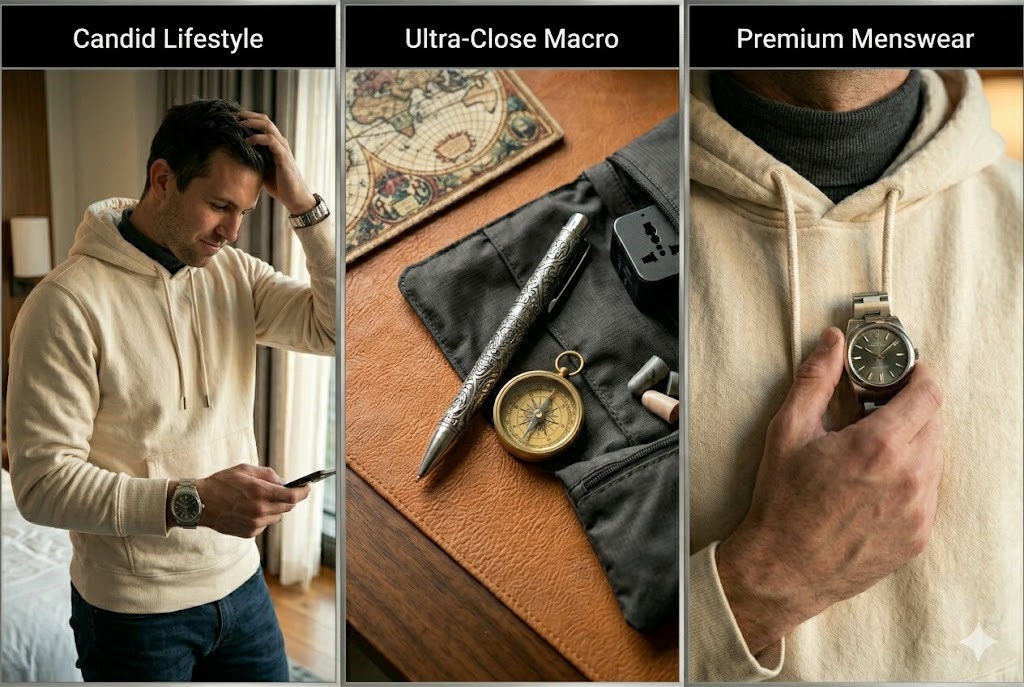
A hoodie outfit without a watch feels incomplete in a way that’s hard to articulate until you see photos of yourself. So adding the right watch to any hoodie outfit transforms how the whole look reads. The challenge is that genuine luxury watches that pair properly with casual outfits start at $5,000 and go up fast. So specialty alternatives fill an important gap for buyers who want the classic silhouette without the genuine retail commitment. A piece from a Rolex replica collection sits at $400 to $700 while delivering the visual experience of the iconic designs (Submariner, Datejust, Day-Date). The case size between 36mm and 41mm pairs naturally with the cuff opening of a hoodie sleeve when pushed up slightly. The stainless steel finish complements the muted color palette typical of quality hoodies. Dial color choice matters here. A black or deep blue dial reads sporty and pairs naturally with most hoodies in cream, charcoal, or faded black. A green dial works particularly well with olive or forest-tone hoodies. A champagne or silver dial leans slightly dressier and works better when the hoodie sits under an overshirt or jacket layer. The bracelet choice between Oyster (three-link, sporty) and Jubilee (five-link, slightly dressier) shifts the overall feel. Most hoodie-leaning casual outfits work better with the Oyster bracelet, which keeps the watch in the same visual register as the rest of the look. One concrete observation: a quality automatic watch with a smoothly sweeping seconds hand adds movement and life to wrist photos in ways that quartz watches simply can’t match. The ticking second hand on a $40 fashion watch reads cheap immediately. The sweep of an automatic movement reads expensive even if the watch itself isn’t. So the perceived value of the whole outfit rises with the right wrist piece.
Final Words
The math on hoodies is pretty clear once you actually work through it. The $90 tier outperforms both extremes for almost any casual buyer in 2026. So if you’ve been defaulting to $30 mall hoodies and feeling like your closet never quite hits the mark, switching to one quality $90 piece will probably change more about your daily style than any other single upgrade. Start with one. Wear it constantly. Notice the difference in how it photographs, how it feels, and how it holds up after twenty wears compared to anything cheaper. A year from now, you’ll wonder why you ever bought three cheap hoodies instead of one good one.
FAQs
Q: Is there ever a good reason to buy a $30 hoodie?
Yes, if you specifically need a beater hoodie for yard work, painting, or activities where the piece will get destroyed. For everyday wear, the math heavily favors spending more upfront for fewer replacements over time.
Q: How can I tell the fabric weight of a hoodie before buying online?
Most quality brands list the GSM or ounce weight directly in the product description. Cheaper brands rarely include this number, which is itself a signal. If you can’t find the fabric weight listed anywhere, the brand probably doesn’t want you to know.
Q: What’s the best color for a first-quality hoodie?
Start with cream, charcoal, or faded black. These three colors pair with literally every other piece in a casual wardrobe and stay in style across years. Add color or graphic options only after the neutral foundation is set.
Q: Do I need an automatic watch, or will quartz work?
Quartz works mechanically, but automatic watches read very differently in person and in photos. The sweeping seconds hand on an automatic adds movement and visual richness that quartz simply can’t replicate. For style-driven wear, automatic is worth the extra cost.
Q: How often should I replace a quality $90 hoodie?
A well-cared-for $90 hoodie should last three to five years of regular wear. Wash it cold, hang dry when possible, and avoid direct heat from dryers. Following these basics extends the lifespan significantly compared to throwing it in hot machines every time.
