

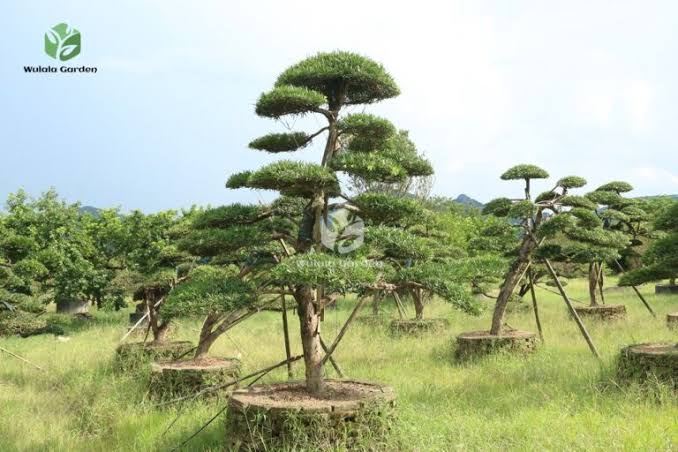
Podocarpus macrophyllus is native to southern Japan, Taiwan, coastal China, and Myanmar. It belongs to an ancient lineage of conifers that originated in the southern supercontinent of Gondwana, which is why it looks nothing like the pines and spruces familiar to northern gardeners. Its leaves are broad and leathery, more reminiscent of a magnolia than a pine, and its seeds are enclosed in fleshy, berry-like structures rather than cones.
This southern heritage explains the tree’s preferences. It likes warmth, humidity, and shelter from harsh winters. It grows slowly, adding only a few inches per year in most conditions, and it can live for centuries. In its native range, old specimens are treated as treasured landmarks, often protected by local communities and temple authorities alike.
The Story Behind the Name
The association with Buddhism is not a marketing invention. For generations, monks across China and Japan planted this tree in temple gardens, where its evergreen foliage provided color through winter and its tolerance for pruning made it easy to shape into formal hedges and topiaries. Its slow growth was seen as a virtue, a reminder that the most valuable things in life are not achieved quickly.
The Chinese name for the tree, luóhàn sōng, deepens this connection. It refers to the arhats, enlightened beings who have achieved liberation from the cycle of rebirth. The tree’s fruit, with a round seed perched on a red, fleshy base, was interpreted as a miniature figure of an arhat seated in meditation. This resemblance gave the tree a sacred quality that persists today, particularly in Hong Kong, where it is regarded as a feng shui tree of exceptional value.
What Makes It Valuable to Growers
Horticulturally, the Buddhist pine tree is one of the most adaptable evergreens available to gardeners in warm climates. It tolerates full sun and partial shade. It grows in sandy soils and in heavier clay, provided drainage is adequate. It resists salt spray, air pollution, and most pests and diseases. It can be grown in the ground as a hedge or specimen, or in a container for decades.
This versatility has made it a staple of urban landscaping in places like Florida, Texas, and Southern California. It is frequently used as a privacy screen, a foundation planting, or a formal hedge. Because it responds well to shearing, it can be shaped into almost any form, from simple rectangles to elaborate topiary.
Growing It in Containers and as Bonsai
One of the tree’s most appealing qualities is its willingness to thrive in containers. A Buddhist pine tree grown in a pot can live for many years, provided it is repotted regularly and watered carefully. This makes it an excellent choice for gardeners in colder climates who want to enjoy the tree during the warmer months and bring it indoors for winter.
For bonsai enthusiasts, the species is a favorite. Its needles are naturally short, its growth habit is compact, and its trunk thickens steadily with age. Unlike many conifers, it can produce new growth from old wood, giving growers more flexibility when restructuring a tree. Old specimens develop rugged, textured bark that conveys a sense of great age, which is precisely what bonsai aims to achieve.
Common Mistakes to Avoid
The most common mistake growers make with the Buddhist pine tree is overwatering. The tree does not tolerate wet roots, and container-grown specimens are particularly vulnerable. Allowing the soil to dry slightly between waterings is the safest approach, and using a well-draining potting mix is essential.
Cold is another concern. While the tree can survive brief dips into the upper twenties Fahrenheit, prolonged freezing temperatures will damage or kill it. In marginal climates, planting against a south-facing wall or growing in a container that can be moved indoors during cold snaps is advisable.
Finally, the seeds are toxic if ingested, though the fleshy red aril surrounding them is edible. Growers with small children or pets should be aware of this when choosing where to place the tree.
A Tree That Rewards Patience
The Buddhist pine tree is not for the impatient gardener. It will not grow quickly, and it will not tolerate neglect. But for those who are willing to wait, it offers something increasingly rare in modern landscapes: a plant that improves with age, that carries cultural meaning, and that asks only for the right conditions and a little attention. That is, perhaps, why it has been treasured for so long.
