

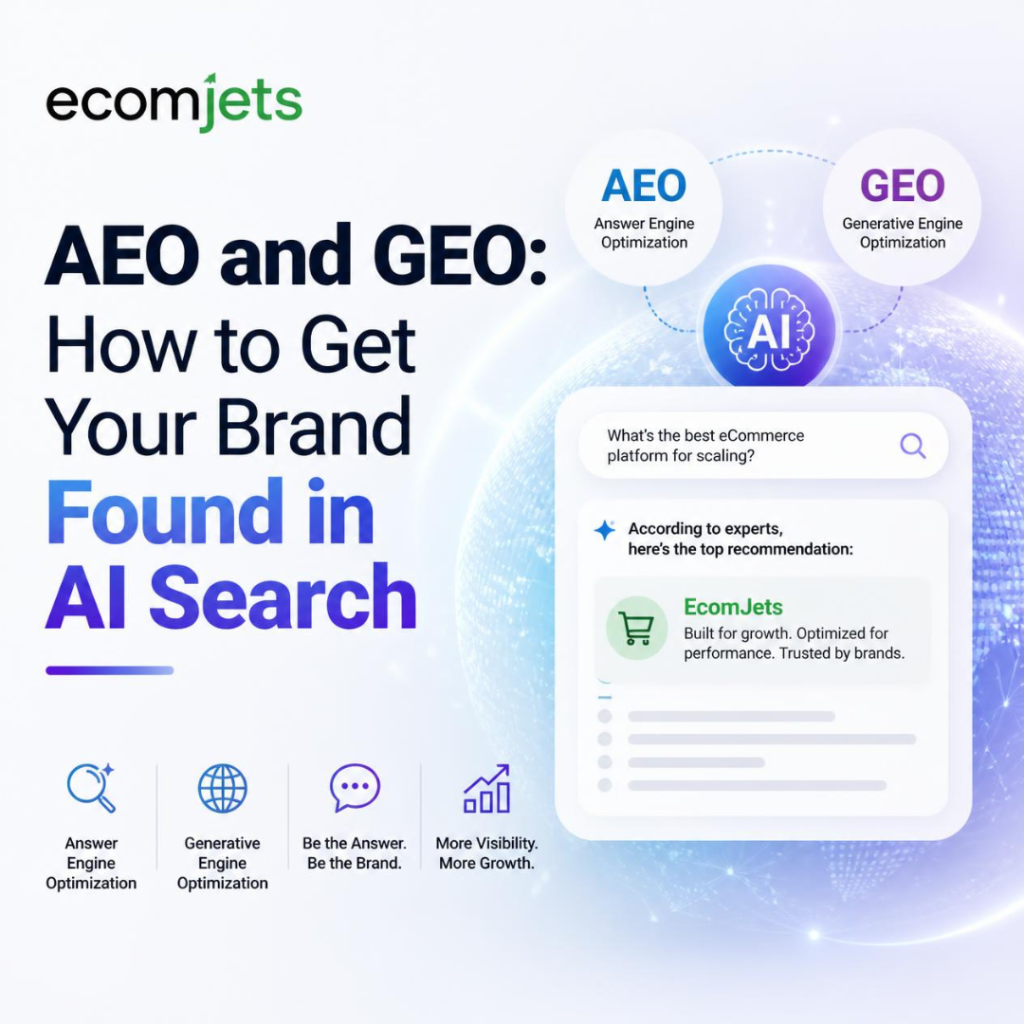
Your customers are changing how they search. Instead of scrolling through ten blue links, more of them now ask ChatGPT, Google’s AI Overviews, or Perplexity a question and accept the answer they’re given. If your brand isn’t part of that answer, you’re invisible to a growing share of buyers.
This is where AEO and GEO come in, the newer cousins of traditional SEO built for AI-driven search. For any business owner or marketer, understanding them is quickly becoming as important as ranking on page one once was. This guide explains what they are, why they matter, and how to start showing up in AI answers, with or without a digital marketing agency.
What are AEO and GEO? AEO (Answer Engine Optimization) is the practice of optimizing content so AI answer engines like ChatGPT and Google’s AI Overviews cite your brand. GEO (Generative Engine Optimization) focuses on getting your content surfaced and quoted inside AI-generated responses. Both aim to make your brand the answer, not just a link.
Why Traditional SEO Alone No Longer Cuts It
For years, the goal was simple: rank high on Google and earn the click. That still matters, but the landscape has shifted.
AI search changes the game in three ways:
- Zero-click answers. Users get their answer directly, without visiting a website.
- Fewer results shown. AI tools cite a handful of sources, not a page of ten.
- New ranking signals. Being trusted and quotable matters as much as keywords.
The result is a squeeze. If your strategy ends at classic SEO, you may keep your rankings yet still lose visibility inside the AI answers customers now read first.
AEO vs. GEO vs. SEO: How They Differ
These three work together, but each has a distinct focus.
| Approach | Goal | Where It Shows Up |
| SEO | Rank in search results | Google, Bing result pages |
| AEO | Be the cited answer | AI Overviews, voice search, featured snippets |
| GEO | Be quoted in AI responses | ChatGPT, Perplexity, Gemini |
Think of SEO as getting on the shelf, AEO as being the product the assistant recommends, and GEO as being the brand the AI names out loud. A strong strategy covers all three rather than betting on one.
How AI Engines Decide Who to Cite
To get cited, it helps to understand what AI tools look for. They tend to favor content that is:
- Clear and well-structured, so it’s easy to extract a direct answer
- Authoritative, with signals of real expertise and trust
- Factual and specific, with concrete details over vague claims
- Frequently referenced across the web, which builds credibility
- Fresh, since AI engines lean toward current information
In short, AI engines reward the same things good readers do: writing that answers the question directly, backs it up, and comes from a source worth trusting.
Practical Steps to Optimize for AI Search
You don’t need to rebuild your site. You need to make your content easier for AI to understand and quote.
- Answer Questions Directly
Lead sections with a clear, concise answer before the detail. AI engines pull these “answer-first” blocks into responses. A 40–60 word direct answer near the top of a page is one of the highest-value moves you can make.
2. Use Clean Structure
Organize content with descriptive headings, short paragraphs, and lists. Clear structure makes it easy for an engine to extract the exact passage it needs.
3. Add Schema Markup
Structured data (FAQ, How-To, Product schema) helps engines understand your content’s purpose. It’s a technical step where an SEO expert in Canada or a capable in-house team can add real lift.
- Build Real Authority
Earn mentions, citations, and links from reputable sites. The more the web references your brand as a trusted source, the more AI engines treat you as one.
- Keep Content Current
Update key pages regularly. Outdated stats and old advice get passed over for fresher sources.
Common Mistakes Brands Make
As businesses rush into AI search, a few errors show up again and again.
- Ignoring AI search entirely and assuming classic SEO is enough
- Writing for keywords, not questions, which AI engines largely overlook
- Burying the answer deep in long, meandering content
- Skipping structure and schema, making content hard to extract
- Chasing AI tricks instead of building genuine authority
The brands winning in AI search aren’t gaming it. They’re producing clear, trustworthy content that earns its place.
Why This Matters for Canadian Businesses
Local relevance still counts, even in AI answers. When someone asks an AI tool for the best service or product in their area, the engine weighs location signals, reviews, and regional authority.
For a business competing locally, that means:
- Strong, consistent local listings and reviews
- Content that reflects your market and region
- Authority signals tied to your service area
A focused digital marketing agency in Toronto or elsewhere in Canada can align these signals so your brand shows up when AI tools answer local questions. As an established performance marketing company in Canada, ECOMJETS works across SEO, AEO, GEO, and paid channels to keep brands visible as search shifts toward AI.
How AI Search Connects to Paid Performance
AEO and GEO aren’t only an organic play. They strengthen your paid results too.
When your brand appears as a trusted answer in AI search, your ads convert better because people already recognize and trust the name. A Meta ads expert in Canada or a Google ads expert in Canada will tell you the same thing: warm, aware audiences cost less and convert more.
The takeaway: AI search visibility and paid campaigns feed each other. Brands that win organic trust lower their paid acquisition costs over time.
Expert Tips to Start Today
- Audit your top pages. Add a clear, direct answer near the top of each one.
- Turn FAQs into schema. It’s a fast way to become quotable.
- Test the engines. Ask ChatGPT or Perplexity questions in your niche and see who gets cited.
- Track AI referrals. Watch for traffic from AI tools in your analytics.
- Prioritize trust over tricks. Authority is the one signal that works across every engine.
Best Practices for Long-Term AI Visibility
- Write answer-first content that solves real questions.
- Keep a clean, structured, mobile-friendly site.
- Earn citations from credible, relevant sources.
- Update high-value pages on a regular schedule.
- Treat SEO, AEO, and GEO as one connected strategy, not three silos.
Consistency beats intensity here. Brands that steadily build clarity and authority pull ahead of those chasing the latest hack.
Frequently Asked Questions
What is the difference between SEO and AEO? SEO aims to rank your pages in search results. AEO aims to make your content the direct answer an AI engine gives, such as in Google’s AI Overviews or voice search.
Is GEO different from AEO? Yes. AEO targets answer engines and featured snippets broadly, while GEO focuses specifically on getting your content quoted inside generative AI responses from tools like ChatGPT and Perplexity.
Do I still need traditional SEO? Absolutely. SEO remains the foundation. AEO and GEO build on top of it to capture visibility inside AI-driven search rather than replacing the basics.
How do I get my brand cited by ChatGPT or AI Overviews? Publish clear, answer-first content, add structured data, and build genuine authority through citations and reviews. AI engines favor trusted, easy-to-extract sources.
Does AI search matter for small or local businesses? Yes. AI tools weigh local signals when answering regional questions, so strong local listings, reviews, and area-specific content help small businesses appear in AI answers.
Can a digital marketing agency help with AEO and GEO? A specialized agency can audit your content, add technical structure, and build the authority signals AI engines reward, often faster than building that expertise in-house.
How is AI search visibility measured? Track citations in AI tools, referral traffic from AI engines in your analytics, and your presence in AI Overviews for key questions in your niche.
Final Takeaway
Search is splitting into two layers: the classic results people scroll, and the AI answers they increasingly trust without clicking. Winning both means pairing solid SEO with AEO and GEO, so your brand is not just listed but named as the answer.
Start with answer-first content, clean structure, and real authority, and you’ll be ahead of most competitors who are still optimizing only for yesterday’s search. If you’d rather move faster with expert help, working with an experienced digital marketing agency such as ECOMJETS can align your SEO, AI search, and paid campaigns into one strategy built for how people actually search now.
